


Trigger point therapy gives you a chance at finally getting rid of those pesky muscle knots that seem to randomly appear and give you pain that you didn’t expect. At Pivotal Motion Physiotherapy in Newmarket, we relieve active trigger points through the application of steady manual pressure.
This method helps relax tight muscles and allows you to regain normal movements once again. If you have suffered from a chronic knot for some time already, don’t hesitate to book an appointment online or by giving us a ring at 07 3352 5116.
What causes trigger points and muscle knots?
A trigger point is a tight bundle of fibres lying inside the muscle. The concept was introduced by Dr. Janet Travell in 1942 after spending many years researching unique muscle structures. If a muscle keeps contracting and does not get sufficient time to rest, it builds up lactic acid, leading to contraction of the surrounding capillaries.
There are many everyday activities that contribute to this phenomenon:
- Slouching when seated at your workstation
- Long periods of sitting down
- Repeating the same motion day after day
- An injury that is not entirely healed
- Constant stress that is keeping the muscles loaded
The human body contains 640 muscles, and a knot can develop almost anywhere, but usually it happens to the neck and shoulders, followed by the lower back region.
What symptoms can trigger point therapy treat?
Understanding trigger points can be quite enlightening because the location of pain often doesn’t match the source of the problem. This phenomenon, known as referred pain, surprises many people. Some of the most common signs are:
The presence of a trigger point in the infraspinatus muscle, located at the posterior aspect of the shoulder blade, will cause pain to radiate from the shoulder to the elbow.
Tension headaches may be caused by tightness in the neck and shoulder muscles, which can also lead to dizziness accompanied by nausea.
Pain in the leg is commonly referred from knots in the lower back or buttocks.
Many people end up addressing the wrong issue for months on end. They might focus on alleviating a headache or soothing an aching elbow, but the real problem often lies in a muscle located just a few centimetres away. Trigger point therapy offers a different approach by tracing the pain back to the specific muscle that’s causing it.
In addition to referred pain, the following issues can also be addressed by therapy:
- Tight muscles and restricted movement
- Localised tenderness
- Numbness or pins and needles
- Muscle stiffness associated with chronic pain
Both active and latent trigger points are effectively treated. Active trigger points cause discomfort even at rest, whereas latent trigger points cause pain only when pressed.
How does trigger point therapy work?
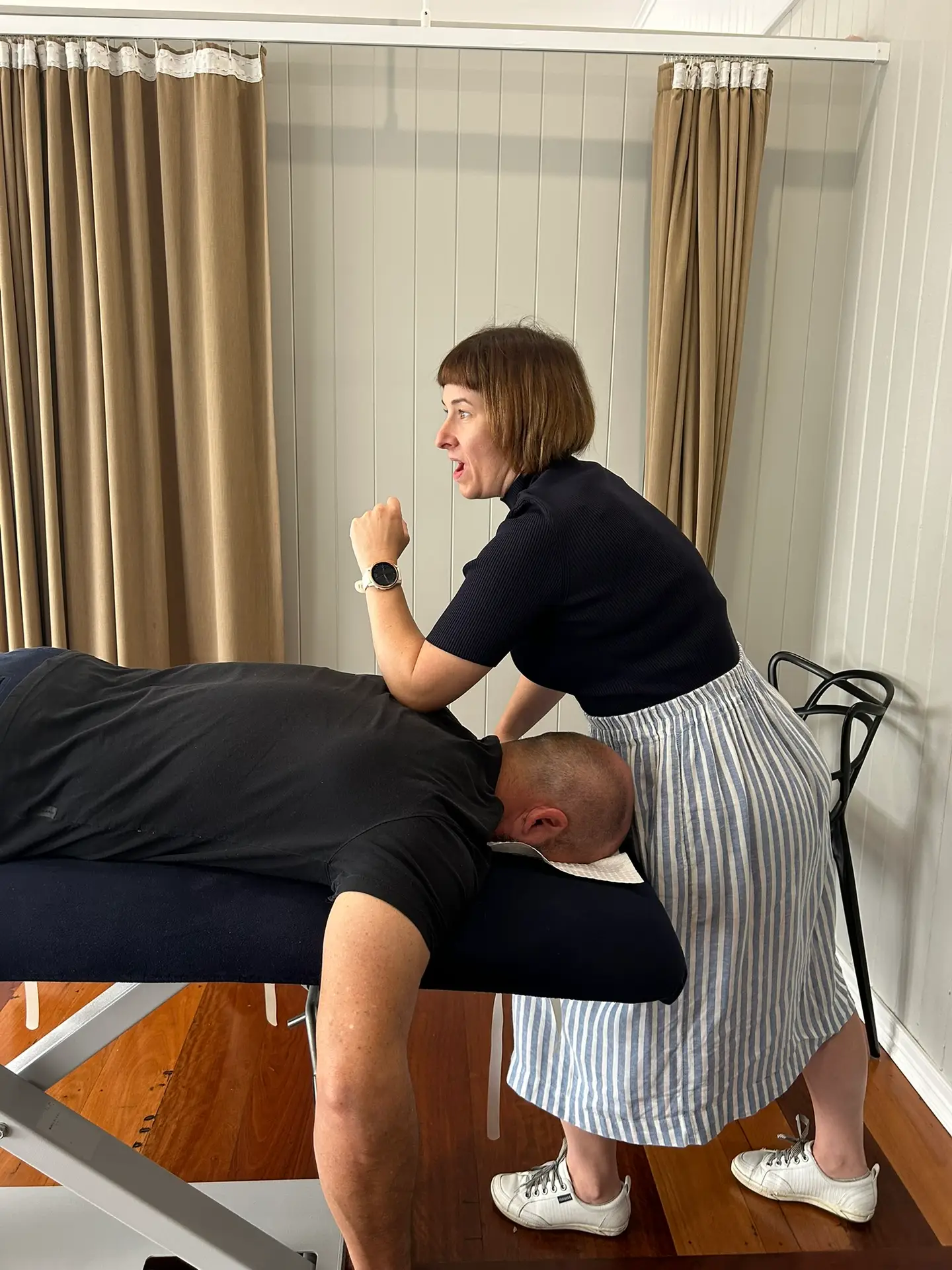
For treatment to be effective, it is vital that the precise muscle at fault be identified. This can prove extremely difficult and usually results in failure when people try to treat themselves. A physiotherapist utilises a hands-on method whereby they palpate the affected areas to locate the tight muscle knot.
Once they locate the trigger point, the physiotherapist applies firm manual pressure directly to the knot. This pressure helps the muscle fibres relax, restoring blood circulation to the area and flushing out trapped waste products. As the tension in the muscle band decreases, the associated pain typically diminishes as well. Depending on the muscle involved, the therapist might also use techniques like dry needling or deep tissue massage to address knots that are difficult to reach with manual pressure alone.
What to expect from a trigger point therapy session
Your first visit to the physiotherapist begins with an evaluation instead of immediate treatment. The therapist will ask about the nature of your pain, its duration, what makes it worse, and how it impacts your daily activities. They will then check your muscles and test how far you can move them to find the source of the pain.
At the point when treatment starts, the therapist exerts direct pressure on the trigger points. It may be very strong pressure, but it must not go beyond what is bearable. Inform the therapist if the pressure becomes unbearable, because the technique should work effectively without causing any sharp pain. The duration of the session is usually between 30 to 45 minutes. When you leave the practice, the therapist may recommend some stretches to make sure that your muscles remain comfortable.
Is trigger point therapy right for you?
The release of the trigger point offers a short-term solution to the problem. Once the knot gets released, your pain reduces, and you might leave the clinic feeling much better. But if the source of your problem persists, then the trigger points will likely recur.
This doesn’t mean the therapy is ineffective. Instead, it serves as an essential starting point rather than a complete solution. For many, it quickly reduces pain and restores some function, allowing them to continue with rehabilitation exercises. Releasing the knot offers a brief period of relief, and how you use that time determines the long-term effectiveness.
Trigger point therapy is helpful if you have muscle knots or referred pain, such as that experienced by people who suffer from headaches that have no clear cause. What is important is that you are prepared to deal with any root causes alongside the therapy. If there is pain due to some other cause, such as joints or nerve problems, simply releasing the knot won’t do any good.
Why choose Pivotal Motion for trigger point therapy in Brisbane
Pressing on a muscle knot provides only temporary relief. The true solution lies in what we build around it, which sets our method apart. Our physiotherapists rely on evidence-based practices. This approach pairs trigger point release with exercises to strengthen and rebalance muscles, alongside posture and ergonomic adjustments to eliminate the daily stress that caused the knot initially. We also give practical advice you can use at home and work to reinforce these changes.
Many wonder if the relief will last. Simply treating the symptom means the knot will likely return. But when you address both the symptom and its root cause, you offer the muscle a real chance to remain relaxed. Our Newmarket clinic has served Brisbane with this approach for over a decade. Accurately identifying a trigger point requires a deep understanding of anatomy and muscle physiology, which is something self-treatment often lacks.
Every session shares a common goal: reducing pain and enhancing mobility with a plan designed to keep you out of the clinic, not just coming back every two weeks.
Book a trigger point therapy session in Brisbane
Don’t let a persistent knot hold you back from your favourite activities. At Pivotal Motion, our team can identify the muscle causing your discomfort and create a personalised plan to ease the pain permanently. Reach out to us at 07 3352 5116 or book an appointment online to begin your journey to lasting relief. Visit us at 240 Enoggera Road, Newmarket.
Frequently asked questions about trigger point therapy
Is trigger point therapy painful?
You are likely to experience some pressure applied to the trigger point, and the intensity might be quite considerable for a short while, but it should not be unbearable. Most patients define the feeling as a “good pain” that subsides once the tension is released from the affected muscle. The level of pressure is regulated by your physiotherapist according to your comfort level.
How many trigger point therapy sessions will I need?
This is dependent on how long they have existed and the cause of the trigger points. Some patients may experience instant relief after one or two sessions, but if the knots are persistent, it may take some more time. Because the treatment is dependent on the cause of the trigger points, your physiotherapist can offer an estimated time during your first visit.
What is the difference between trigger point therapy and dry needling?
Trigger point therapy is the more general form of treatment involving the application of continuous pressure or various methods for releasing knots. Dry needling is one of the tools used during trigger point therapy, which involves the insertion of a needle into the trigger point that cannot be reached by manual pressure alone. Your physiotherapist may use either technique, or both, depending on the muscle.
Is trigger point therapy the same as remedial massage?
No. Remedial massage is carried out over a larger group of muscles in order to relieve general tightness, whereas trigger point therapy concentrates on individual trigger points as well as the referred pain from them. Trigger point therapy also usually makes use of more direct pressure applied to a certain area rather than flowing strokes.
How long does a trigger point therapy session take?
Typical sessions last anywhere from 30 to 45 minutes. The initial session will take more time, as you will undergo a thorough assessment prior to your treatment.
Is it normal to feel sore after a trigger point therapy session?
Temporary mild soreness lasting for one to two days is normal and to be expected. It would be akin to what you normally feel after a good workout. Hydration and gentle movement, such as the stretches assigned to you by your physiotherapist, will make sure that the soreness resolves itself.
